
A few years ago, I took a group from my previous church on a spiritual retreat to New Mexico.
We toured a lot of very beautiful and sacred sites. And, while we were there, we also got a private tour of the home of the famous American artist, Georgia O’Keefe.
And, it was incredible to be standing in the place where she painted some of her most famous works of art. We could reach out and touch the actual tree and the ladder and the doorway that inspired some of her greatest paintings.
When I was a younger, I got to tour another famous home. It was home of the poet, Emily Dickinson, in Amherst, Massachusetts, and it was amazing to be standing near the actual desk where she wrote over 1,800 poems.
And, of course, millions of music lovers travel to Graceland every year to tour the home of Elvis Presley.
Lovers of art and poetry and music want to experience first-hand the places where the creative spirit came into being.
So, of course, it is no wonder that those of us who are lovers of Jesus want to experience the Holy Land for ourselves…the place where he came into being.
We want to stand where Jesus stood and to walk the roads he walked.
A few years ago, one of my congregants returned from a visit to the Holy Land, and he excitedly told me, “Pastor Sal, I got to touch the exact spot where Jesus was born, and I got to see the empty tomb with my own eyes. I got to walk the road to Emmaus which Jesus walked.”
And, he was so moved and excited telling me all this that I didn’t want to burst his bubble and to tell him that the sites he visited most likely weren’t the actual sites where Jesus was born, or walked, or laid to rest.
Archeologists agree that most of the sacred sites in the Holy Land no longer exist in their original form, and historians agree that many of the ancient documents pointing towards those sites are often fragmentary or ambiguous, at best.
If you were with us a few weeks ago on Maundy Thursday, we spoke of the “Via Dolorosa,” which is the road that Jesus walked towards his death. Millions of pilgrims walk this road each year and have been doing so for centuries.
Yet, you may have also seen the NBC Nightly News segment recently where archeologists and historians now view this route as incorrect. They say the Via Dolorosa would have been on a completely other side of town.
And, as we heard in our “Words of Integration” this morning, historians also tell us that there is absolutely no record of any town called Emmaus, other than in this one story from Luke’s gospel, which I just read for you.
Yet, today, there are six different sites in the Holy Land which claim to be the road to Emmaus.
So, which is it? Well, I don’t think it really matters that much, because no matter where we are, we are standing on Holy Ground. We don’t have to visit the Holy Land to experience the power and presence of Christ.
I think that’s why the late theologian and Biblical scholar, Marcus Borg, once declared that “Emmaus is nowhere and everywhere.”
I love that. That’s the truth. And, I love that the word “nowhere” is spelled “NOW HERE.” Because Emmaus is now and it is here and it is everywhere.
Another Progressive Christian theologian, John Dominic Crossan, says, “The Road to Emmaus never happened. The Road to Emmaus happens every day.”
The Emmaus story – like many of the stories in the Bible – is not intended be understood as literal history. These are symbolic stories which reveal great spiritual Truths.
So, let’s look at the story of the Road to Emmaus symbolically or spiritually.
First off, the word “Emmaus” is a Hebrew word meaning “Warm Spring” – Spring, of course, symbolizes NEW GROWTH and NEW LIFE.
And, we hear in the first sentence of the story that Emmaus is SEVEN MILES from Jerusalem.
I’ve told you many times before that the number 7 has a great spiritual significance. It is the number mentioned most often in the Bible. The creation story is 7 days; there are 7 “I AM” statements of Jesus; Jesus says to forgive “70×7” times. In Revelation, there are 7 signs. That’s just a few of many examples.
And, we know there are 7 seas, 7 colors of the rainbow, 7 chakras, and 7 days of the week.
Metaphysically, the number 7 symbolizes SPIRITUAL COMPLETION.
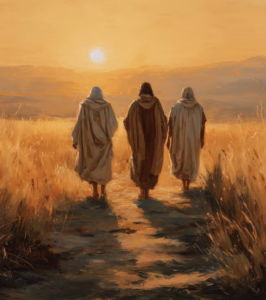
Emmaus is 7 miles from Jerusalem, which is the Holy City. So, metaphysically, the Road to Emmaus symbolizes our SPIRITUAL JOURNEY to Wholeness, to Holiness.
The two disciples in today’s story begin in a place of darkness, sadness and confusion. Their teacher – the man they thought was going to save them – has been brutally crucified.
But as they journey to Emmaus, their minds are opened and their hearts are lifted.
You see, they were not alone on that walk. Remember, before he died, Jesus said, “When two or three are gathered in my name, I am with them.” In my NAME means in my SPIRIT.
Jesus was with them. Jesus was walking with the two men on the Road to Emmaus, but – AT FIRST – they don’t recognize him.
And, why is that? If they were his students and his friends, why wouldn’t they recognize him?
It’s just like the gospel story we heard a few weeks ago, how Mary Magdalene thinks she’s talking to a stranger (whom she assumes is a gardener) outside the empty tomb. She, too, doesn’t recognize Jesus, at first.
What this symbolically means for us is that the Living Christ is within in our midst, dwelling among us, here and now, but we are often blind to it.
The two men on the road to Emmaus don’t see, at first, but – after spending the day walking and talking with this stranger in their midst and breaking bread with him – their eyes are opened and they recognize Christ in a stranger.
Remember when Jesus said, “When I was hungry, you gave me to eat. When I thirsty, you gave me to drink. When I was naked you clothed me. When I was sick you visited me.”
And, the disciples said to him, “Rabbi, when did we ever do those things.” And, Jesus said, “When you do it for the least of these, you do it for me.”
We, my friends, we walk the Road to Emmaus each and every time we recognize the Christ in one another, especially in the stranger, the outsider, and the least of these.
The two men on the Road to Emmaus welcome the stranger, they share a meal with him, and they begin to understand Scripture in a new light.
The story tells us that, “Beginning with Moses and all the prophets, Jesus interpreted all of the scriptures to them.”
Jesus wasn’t merely quoting Scripture to them. He was INTERPRETING it, and so should we.
Taking the Bible literally will not give you a new understanding. Scripture is symbolic and requires metaphysical interpreting.
This is what opens people’s minds to new understanding…in a way that THE LITERAL cannot do.
The greatest gifts I receive is when one of you tells me, “Pastor Sal, I have been hearing these Bible stories my whole life, but now I am understanding them in a new light. Now, they’re making sense to me. Now, I get it!”
The two disciples in today’s Gospel story finally get it. Jesus – the stranger in their midst – has opened their minds….and then he opens their eyes in the BREAKING of the BREAD.
We, my friends, walk to road to Emmaus every time we “break bread” with one another.
In our Words of Integration this morning, we heard that word COMPANION comes from a Latin word which literally means “WITH BREAD.”
We are COMPANIONS on the JOURNEY. We’re all walking the Road to Emmaus together.
Or, as the late spiritual teacher. Ram Dass, once said, “We’re all just walking each other home.”
When we recognize the Divine in one another – when we honor the Light in one another – we experience the Christ in our midst, and the resurrection is real. Very real.
Whether the Holy Land sites are accurate or not, I don’t know, but what I do know is that millions of people who journey there (Christians, Jews and Muslims) experience the presence of the Divine in a very real way.
My congregant who visited the Holy Land told me he had an A-ha! moment as he was walking the Emmaus road.
He said, “I realized that EMMAUS and EMMANUEL have the same root word, which means GOD IS WITH US. And, I realized that God was with me as I walked the Road to Emmaus.”
He got it! And may we get it, too.
As we walk together on the spiritual road this Easter season — as we journey to towards the place of Wholeness together — may we recognize more and more fully the Divine Light that dwells among us, with us, and as us.
Let us open our eyes and see that the Road to Emmaus is now and here and everywhere.
May it be so. Amen.
Here are three follow-up questions for reflection and/or journal writing:
- Where in your everyday life might you be overlooking the presence of the Divine, and what practices could help you “recognize Christ in the stranger” more fully?
- The sermon suggests that spiritual truth is found through interpretation rather than literalism—how has your understanding of faith or scripture evolved when you’ve looked at it symbolically or with fresh perspective?
- If the “Road to Emmaus” represents a shared journey toward wholeness, how are you showing up as a companion to others—and how are others helping guide you along your own path?