
Some of you know that before I became a pastor, I was a high school English teacher, and to this day, I just love playing around with words. I especially love “mash-up” words, which is when you put two words together to create a new word. The official name for it is “portmanteau.”
Most of you are familiar with portmanteaus like “brunch” (which is a combination of breakfast and lunch) and words like “smog” (which is a combination of smoke and fog).
More recent mash-up words are “blog” (a combination of web and log) and “dramedy” (which is a combination of drama and comedy).
And, in recent years, we also heard another new mashup word called “SHEEPLE.” Sheeple is a combination of “sheep” and “people.”
On cable news shows, people on the left began calling people on the right “sheeple,” and people on the right began calling people on the left “sheeple.” The word got used so much that it’s now in the dictionary!
Dictionary.com defines the words “sheeple” as: “People who are easily persuaded and tend to follow the crowd.”
Sadly, our churches are not immune from this. There seems to be this sheeple behavior – this herd mentality – in many Christian churches in our country today, where conformity and blind obedience are practiced, and where individuality and critical-thinking are discouraged.
It’s why we have Christians who refuse to believe in science and evolution, and instead believe in a talking snake.
People who believe without questioning – people who blindly follow a group (be it a religious or political group) without critical inquiry or rational thinking are people who belong to a cult.
We here at The United Church of Rowayton don’t want anyone here to be involved in a cult. We don’t want anyone to have to “check their brain” at the door before coming walking into our church.
Yes, we are a Christian church, part of a Christian denomination, but we say on the sign at the entrance of our church that “we believe there is more value in questioning than in absolutes.”
That doesn’t mean that we are not people of great faith. It fact, just the opposite is so. Many people think that if you doubt or question something about your religion, then your faith must not be very strong.
But, the contemporary Christian writer, Anne Lamott, says, “The opposite of faith isn’t doubt. The opposite of faith is certainty.”
The opposite of faith is certainty. There are so many Christians today who are so certain that they have the answer…not just for themselves, but for everyone.
But that isn’t faith. Certainty is the opposite of faith.
In the New York Times last year, there was an editorial entitled, “God is a Question, Not an Answer,” written by Professor William Irvin. He said:
“Belief without doubt would not be required by an all-loving God, and it should not be worn as a badge of honor. People who claim certainty about God worry me, both those who believe and those who don’t believe. They do not really listen to the other side of conversations, and they are ready to impose their views on others. It is impossible to be certain about God.”
It’s impossible to be certain about God.
Most people of great faith that I know are people who express doubt.
Even Mother Teresa expressed doubts. In journal entries that were published after her death, she wrote that she had doubts that God even existed.
That doesn’t mean she wasn’t a person of great faith. It means that she was.
The Christian theologian, Paul Tillich, wrote: “Doubt isn’t the opposite of faith. Doubt is an element of faith.”
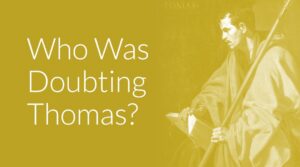
And that’s why I always thought that the apostle Thomas got a bad rap. We’ve come to refer to him as “Doubting Thomas.” He was considered the “bad apostle” because he had questions and doubts.
But, let’s look at today’s Gospel story for the 2nd Sunday of Easter together.
The other apostles were locked away in a room all week. Jesus – who they thought was the messiah who would save them – had just been crucified.
I guarantee you that they were expressing a lot of fear and a lot of doubt while they were gathered in that room. I’m sure they were doubting whether or not they had been right about Jesus.
So, Thomas, I’m sure, wasn’t the only one with doubts.
What I think Thomas is saying to the others in today’s Gospel reading is: “Look, you guys had a vision of the resurrected Jesus. You experienced him firsthand, and that’s why you believe. Well, I want to have that experience, too, and then I’ll believe.”
He wasn’t calling the other apostles liars. He was simply saying that he, too, wanted to have an experience of the risen Christ just like they had.
He wanted to know it for himself – first hand – rather than believe some second-hand account.
And, look what happens! Jesus doesn’t punish Thomas for having doubts. Jesus rewards him for his questioning and his doubts.
Jesus gives Thomas the first-hand experience he was asking for. Jesus says, “Touch Me”… feel my Aliveness!
Some of you may know that there is actually a Gospel of Thomas, but it is not in the Bible.
The Gospel of Thomas is one of the Gnostic Gospels that was discovered in 1945 in Egypt, and has been verified by historians and theologians.
When the Bible was being compiled by the early church, they decided not to include the Gospel of Thomas and the other gnostic gospels, and they hid those writings until they were discovered in 1945.
Who were the Gnostics? The Gnostics were early Christians like Thomas who believed that we could experience that Christ presence for ourselves first-hand.
The word “gnostic” means “knowing”… but it’s not knowing of the head – it’s not intellectual knowledge. It means INTIMACY, an INNER knowing. A knowledge of the heart.
It’s about having a first-hand knowledge of the Christ…not because someone told you about it (or because you read it in a book), but because you yourself have experienced it first-hand.
I told you last Sunday during my Easter message that many people have doubts about the resurrection stories in the Bible, but that I know that the Resurrection is real because I have experienced it first-hand for myself.
I have felt the presence of Christ alive in me!
And, like Thomas, I would not have felt the “aliveness of Christ” without my doubts and questions. They have not weakened my faith…they have strengthened it.
My friends, all of us are on a Spiritual Journey, a Spiritual Quest, and the word “quest” is part of the word “questioning.”
I believe that unquestioned beliefs are our greatest obstacles on the spiritual path. These are the beliefs and thoughts we’ve unknowingly and unquestioningly taken on from our churches, our parents, and our society…beliefs that we have never questioned.
In Romans 12:2, it says, “Be ye transformed by the renewing of your mind.”
That is why prayer and meditation are so important on the spiritual quest, because all of our answers are within.
When we “become still and know,” we renew our minds, we transform our thinking, so that we can – like Thomas – experience first-hand intimate knowledge of the Divine Presence.
And, so, as we enter into this Easter season, let us go forth to experience the risen Christ for ourselves by bringing our doubts and questions to the Light.
Let us be people humbly “Living the Questions,” rather than people arrogantly proclaiming that we have everyone’s answers.
May it be so. Amen.
Here are three follow-up questions for reflection and/or journal writing:
- Where in your faith (or worldview) might you be practicing “certainty” instead of openness—and how could embracing honest doubt deepen your understanding rather than weaken it?
- In what ways have you relied on second-hand beliefs (from family, church, or society), and what would it look like for you to seek a more personal, first-hand experience of truth or the divine?
- How can you actively “live the questions” in your daily life—through practices like reflection, conversation, prayer, or meditation—rather than rushing toward easy or absolute answers?