
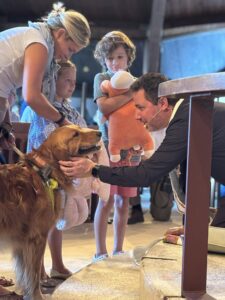
Today, we are celebrating the “Blessing of the Animals,” because later this week is the Feast Day of St. Francis of Assisi, the Patron Saint of Animals.
St. Francis loved animals so much! In fact, when Francis was a young priest, he would go outside and practice his sermons on the birds. No joke! He would actually go out into the forest and give a sermon to the animals.
There is a beautiful movie about the life of Saint Francis called, “Brother Sun, Sister Moon,” because he saw the sun and he moon as our siblings.
In fact, some say that Saint Francis was the very first person to coin the term, “Mother Earth.”
St. Francis wanted us to recognize that all of Creation belongs to God.
He said, “All things of creation are CHILDREN of God, and thus are our BROTHERS & SISTERS.”
Animals are our brothers and sisters! God created them, and God created us, so we’re all God’s children, members of the same family.
For many years, Gregg and I had a cat named Oscar. Like St. Francis, we talked to him all the time, and we loved him like our child. He was a member of our family.
Sadly, Oscar passed away during the pandemic, and although it’s been almost five years now, in many ways, we are still grieving. Our hearts are still hurting.
I know that many of you have also had to say tearful goodbyes to your beloved pets, and it is never easy, is it?
You know, we hold Memorial Services here in the church when our human loved ones die. I wonder why we don’t hold Memorial Services when our animal loved ones die? I mean, they’re part of our families, right?
Animals have souls and spirits just like we do.
In fact, the word “animal” comes from the root word “ANIMA” which is Latin for SOUL.
Animals have souls and spirits, and they help connect us to our souls and spirits. They help connect us to God.
I love that quote on the front cover of our bulletin today: “Until one has loved an animal, a part of one’s soul remains unawakened.”
The Bible, of course, if full of animal references, from the Noah’s Ark story to Jonah and the Whale to the “lion and the lamb” lying down together.
Jesus used animals as examples in many of his parables and teachings. For instance, he referred to himself as the shepherd and us as the sheep, and (in today’s gospel reading) he told us to look to the “birds of the air” as a demonstration of God’s love.
One of my favorite passages from the Bible comes from the Book of Job, and it says: “Ask the animals what they think – let them teach you; let the birds tell you what’s going on. Put your ear to the earth and learn. Listen – the fish in the ocean will tell you their stories. Isn’t it clear that they all know and agree that God is in the life of every living thing?”
I just love that: “Listen to the animals. Let them teach you.”
Animals are spiritual teachers for us. They teach us how to be fully present, to be in the now moment, and to experience God’s unconditional love first-hand.
Studies have shown that having a pet provides a range of significant mental, physical, and social benefits, including reducing stress, improving cardiovascular health, fostering physical activity, and decreasing loneliness through companionship and increased social interaction.
The medieval Christian mystic, Meister Eckhart, once wrote, “If I spend enough time with the tiniest creature – even a caterpillar – I would never have to prepare a sermon. So full of God is every creature.”
So full of God is every creature! God’s life is in every living thing!
I know that the more that I grow in spiritual consciousness, I find it harder and harder to swat a fly or to kill a spider in my home. Because I am beginning to realize that the life that animates them is the same life that animates me: the life of God.
The Life and Light of God is in our dogs and our cats, and it is also in the animals we hunt for sport and those we eat for food.
Now, I am not a vegetarian, but I know that some of you are…some for health reasons, and others for spiritual reasons. Many of the world’s greatest spiritual teachers throughout the centuries have been vegetarians for spiritual reasons.
A few years ago, the organization known as PETA (People for the Ethical Treatment of Animals) put billboards up around the country proclaiming: “Jesus Was a Vegetarian.”
Biblical scholars have theorized that Jesus may not have been a meat eater.
When the Dead Sea Scrolls were discovered in the 1940’s, we learned more about the Ebionites, who were followers of Jesus after his death. They were led by James, the brother of Jesus.
From the scrolls, we learned that the Ebionites were not meat eaters, so it would make sense that if they were the earliest followers of Jesus that they would be following the Way of life that he himself led.
And, we know that Jesus was heavily influenced by his cousin, John the Baptist, who also did not eat meat.
I certainly don’t know if Jesus ate meat or not, but I do know that he was a man of great love and compassion and non-violence…a man who would not cause harm to another living thing.
In the Creation Story from the Book of Genesis, it says that God created humans in the image of God so that they would be responsible for the fish in the sea, the birds in the air, and every animal that moves on the face of the Earth.
It said that God gave us humans dominion over the animals, but dominion, my friends, does not mean domination.
To “dominate” means to conquer. But “dominion” means stewardship. It means we are called to be God’s stewards — God’s caretakers — of the animals.
And, isn’t it interesting that in the Creation Story, God says to Adam and Eve: “I’ve given you every sort of seed-bearing plant on Earth and every kind of fruit-bearing tree. I have given them to you for food.”
God doesn’t say, “I have given you the animals for your food.” God says, “I’ve given you plants and fruit trees for your food.”
Now, as I said, I am not a vegetarian, and I’m not advocating that we all become vegetarians, but I am encouraging those of us who eat meat to educate ourselves about the treatment of the animals that we eat.
If we are to be caretakers of the animals – which God has instructed us to be – then we must make sure that we act humanely and with compassion in our treatment of them, for God gave them life.
The contemporary spiritual teacher, Eckhart Tolle, says that he believes that animals are closer to God than we are. He says they are closer to the Source because they are not caught up in the veil of the mind.
I tell you this week-after-week, it seems, but in order for us to connect with the Source – to connect with God – we must go beyond the mind, beyond our thinking, beyond our negative thoughts, worries and fears.
I guarantee you that your dog is not stressed out at all about what’s going on in Washington, or what’s happening with the economy.
It’s like what Jesus said in today’s gospel reading about the birds. He said, “Look at birds in the air. They don’t worry. God meets their every need.” He says, “Which of you can add a single hour to your life by worrying.”
So, today, my friends, let us not only give thanks to God for the animals in our lives, but let us also give thanks for the spirituality of animals which reminds us of God’s unconditional love and care for us.
And, let us recommit ourselves to being better stewards of all the creatures — great and small — which God has entrusted to our care.
Questions for Personal Reflection:
- How have the animals in your life revealed something to you about God’s presence, unconditional love, or care?
2. What does it mean for you personally to live as a steward of God’s creatures, rather than as a dominator over them?
3. In what ways might you deepen your spiritual practice by paying more attention to the lessons of creation—listening to the “sermons” of birds, pets, or even the smallest creatures around you?