
Today is the 4th Sunday in Lent, and during this season of Lent this year, the Church is having us focus on the Gospel of John (the last of the gospels to be written) which I told you before is most highly symbolic gospel.
For example, two Sundays ago, we heard the story of Jesus telling a man named Nicodemus that he needed to be “born again.” Nicodemus was so confused. He said to Jesus, “How can I go back inside my mother’s womb?”
Jesus, of course, wasn’t talking about physical birth. He was talking about spiritual birth.
And, last Sunday, we heard the story of the Woman at the Well. Jesus told her that he had living water for her, and she replied, “Man, you don’t even have bucket!”
She thought he was speaking of physical water, but Jesus, of course, was speaking of spiritual water.
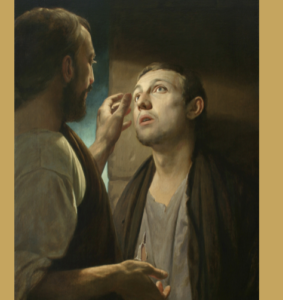
And, in today’s gospel reading, we hear the story of a blind man whose sight has been restored, but it’s not really so much about physical sight, as it is about spiritual sight.
As Jesus says in today’s reading, “I have come so that the blind may see.” He’s not talking about physical blindness. He’s talking about spiritual blindness.
Most of you know the words to the hymn “Amazing Grace,” in which we sing, “I was once lost but now am found/Was blind but now I see.”
When we sing that, we’re not saying we were physically blind, but spiritually blind. So, today’s gospel reading is really about healing our spiritual eyes, so that we can begin to see things more clearly.
Many of you know that Jesus was Jewish. And, growing up in a Jewish household, he would have been taught from the Talmud, the ancient Jewish scripture.
And, in the Talmud, there is a famous quote about “seeing.” It says, “We don’t see things as they are. We see things as we are.
What does that mean? Well, let me give you an example: Let’s say I held up a picture this morning of a smiling 7 year old boy and his dad. They’re both earing camouflage and holding rifles. And, they’re posing in front of a dead deer. The caption of the photo says: “Little Billy’s first kill.”
Some of you would look at the photo and think: “Oh, that is so cute. What a precious father/son moment that Billy will always cherish. Dad must be so proud of him!”
Others of you, however, will look at the very same photo and think: “How horrible for a little boy to kill an innocent animal. Giving a little child a gun and teaching him to kill is a form of child abuse.”
How could we look at the same photo and have such different reactions?
Because we don’t see things as they are. We see things as we are.
And, the reason we have such DIVISION in our world today isn’t because people have such differing VISIONS, but because we’re unwilling to engage with those who see things differently than we do…unless, of course, it’s to belittle them and to tell them how wrong they are and how right we are.
The world in which Jesus lived was also a world of great division. People judged one another harshly because of their differences.
For example, in today’s gospel reading, the disciples ask Jesus about the blind man: “Who sinned – this man or his parents – that he was born blind?”
You see, people in Jesus’s day actually believed that if you had a disability or a disease (like leprosy), it meant that you had sinned and that God was punishing you. So, you were viewed as an outcast.
They also believed that foreigners (such as the Samaritans) were unclean, and they believed that women were inferior and the property of men.
Jesus, however, comes along with a different vision, a NEW vision! He sees through the eyes of God. Not through the eyes of fear, but through the eyes of LOVE. Not through the eyes of separation and division, but through the eyes of Oneness.
Jesus says in the gospels, “All people are sons and daughters of God. All people are holy and precious in God’s sight.”
And, he demonstrates this by doing some shocking things: He befriends the unclean, he shares meals with outcasts and foreigners, and he invites women to join his ministry.
And Jesus envisioned (and proclaimed) that he was going to bring about a new world order: one in which he said, “the last will be first” and the “least of these will be the most important.”
As we hear in Luke 1:52, it says: “The rich and powerful will be pulled down from their thrones and the lowly will be lifted up high.”
Those words, those actions, THAT VISION would lead to Jesus’s arrest and crucifixion.
So, what does it all mean for us today?
Well, if we are to truly call ourselves Christians (followers of the Way of Jesus) than we better have the same vision of people that Jesus did, right? Jesus loved people unconditionally, and we are called to do the same.
Sadly, that isn’t the case in a lot of our Christian churches today…churches (in Jesus’s name) that judge and exclude people based on certain conditions, like what they look like, who they love, how they vote.
Our vision, my friends, has become clouded, muddied. Our eyes are in need of some spiritual cleansing.
The Season of Lent is the perfect time for us to renew our vision. It’s a 40-day period of prayer and fasting and self-reflection.
In prayer and meditation, we close our physical eyes (our human eyes), so that we can see people and things from a Higher Perspective, from the Realm of Spirit.
And, we fast: we fast from our narrowmindedness, our judgements, and our biases, all of which are based in fear.
And, as we “give up” these things for Lent, we slowly begin to heal, so that we can experience resurrection and new life.
And, so, my friends, in the remaining days between now and Easter, I hope you will find time each and every day to fast and to pray, so that you may begin to see things more clearly, to love one another more dearly, and to follow in the Way of Jesus more nearly.
May it be so.
Here are three follow-up questions for reflection and/or journal writing:
-
Where might I be experiencing “spiritual blindness” in my life right now—especially in the way I see or judge other people?
-
How might my own experiences, beliefs, or fears shape the way I see others, and what would it look like to see them more through the eyes of love, as Jesus did?
-
During this Lenten season, what is one attitude, bias, or judgment I can “fast” from so that my vision becomes clearer and I can follow the Way of Jesus more closely?