
Most of you know, this year, our church is celebrating its 75th Birthday. We’re also celebrating our 15th birthday as an “Open & Affirming” church. And, of course, our country is celebrating its 250th birthday this year.
But, older than all of those birthdays is the birthday of the Christian Church, which we are celebrating today.
Pentecost Sunday is known as the birth-day of the Christian church, and, today, we are 1,996 years old.
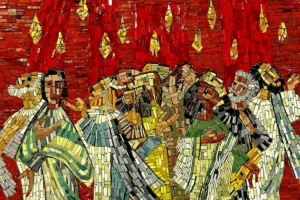
And, just as we light birthday candles, today, we’re celebrating the day that the flames of Holy Spirit ignited over the heads of the apostles and set their minds and hearts on fire.
That’s why we’re wearing red today to symbolize the fire of the Spirit.
In Scripture, whenever “fire” is mentioned it’s used to symbolize the Presence of the Divine, the Light of God.
And, when we think of fire stories in the Bible, we usually think of two stories: we think of the Pentecost story from Acts of the Apostles, and we think of the story of Moses and the burning bush.
These two stories – one from the Old Testament (the Jewish Scripture) and one from the New Testament (the Christian Scripture) – are very similar stories.
This is no coincidence. The early Christian writers of the New Testament were writing to a Jewish audience, and they were trying to demonstrate that Messiah promised them in Old Testament (in the ancient Jewish Scripture), was indeed Jesus of Nazareth. So, they wanted to stories to “match up.”
For example, the Jewish Scripture said that Moses was atop Mount Sinai for 40 days and nights, and, so, Gospel writers of the New Testament wrote that Jesus also spent 40 days and nights in the wilderness.
The Old Testament writers said that Moses on the mountaintop was transfixed by the light of the burning bush, and so the New Testament writers also tell a story of Jesus on a mountaintop being transfixed in the Light of God.
Again, they were trying to demonstrate that Jesus was the Messiah (the new Moses) that had been promised in the Old Testament.
All of the Jewish people at the time the New Testament stories were being written would have been familiar with the story of Moses and the burning bush from the Book of Exodus.
In that story, Moses goes up to a mountaintop. Now, I’ve told you before, whenever we read “mountains” in the Bible, it symbolizes a place of higher consciousness.
From that mountaintop (from that place of higher consciousness), Moses encounters the burning bush, which symbolizes the Light of God, the Presence of the Divine. And, it is from that place of higher consciousness that he also hears the voice of God speaking to him.
And the voice of God instructs Moses to go back down the mountain and to lead his people from exile (separation) to the Promised Land (the place of Oneness).
The Jewish people of Jesus’s day loved this story of Moses and the Burning Bus so much that they commemorated the story every year. This commemoration took place 7 weeks after Passover.
Now, I’ve told you before, that “7” is very spiritual number. It signifies “spiritual completion.” So, after 7 weeks – 49 days – the Jesus people celebrated the story of Moses and the Burning Bush on the 50th day, which is what the word “Pentecost” means: 50th Day.
Now, fast-forward to our New Testament reading today: the apostles are gathered together in a room celebrating the Jewish Pentecost – 50 days after Passover.
They are not up on a mountaintop like Moses, but they are in what’s known as the Upper Room, again signifying a place of higher consciousness.
And, from this place of higher consciousness, they, too – like Moses – experience fire, the Divine Presence.
It’s not a burning bush, this time, but in tongues of fire above their heads, right at the crown, the place of Enlightenment.
And, like Moses, they also hear the voice of God speaking to them in tongues and communicating to each of them in their own way.
And, after they left the Upper Room – after they came down from their Mountaintop experience – the apostles went far and wide to communicate this voice of God to others, so they could lead them from separation to Oneness, just as Moses did to his people.
The Jewish Pentecost celebrating Moses – was 50 days after Passover – and so our Christian Pentecost celebrating Jesus – is today: 50 days after Easter.
But there is one major difference between these two stories. The Old Testament story is about the “Chosen People” being led to freedom, but the New Testament story indicates that ALL are God’s chosen people.
Look what it says in today’s reading – Jews, Arabs, people from Libya and Egypt and Rome, slaves and free, old and young – all of them “got it” in their own language, in their own culture, in their way, signifying that we are all of One Spirit.
So, today, my friends, we are not just commemorating a story from the Bible. The Pentecost story is about us and it’s about right now.
The Fire, the Light, the Divine Presence is still making itself known to us, just as it did to Moses and the apostles. God is still speaking to us to today, and we can hear God’s voice just as clearly as Moses and the apostles did.
So, how do we do experience that Light and that Voice? The stories tell us: By going to that place of Higher Consciousness.
That’s what prayer and meditation and mindfulness practices do for us. They transform our lower self into our highest self.
In prayer and meditation, we focus on our breathing. The Latin word, “Spiritus” means breath. As we connect with our breath, we connect with Spirit.
In prayer and meditation, we close our human eyes (which see only at the worldly level) and put our focus on the upper room (that place between the eyebrows…that place of higher consciousness).
Our Eastern brothers and sisters refer to this as the Third Eye (or the Divine Eye), the same place that Jesus spoke of in Matthew 6:22, when he said in “If thine eye be single, thy entire body will be filled with light.” The Light of God.
In the quiet (in the silence of prayer and meditation), we leave the noise of the world below and we attune ourselves more fully to that inner voice, the voice of Spirit within us.
All of who are experienced meditators out there know that there are great moments of joy and bliss when you experience this Light and this voice. So, you can understand why the apostles appeared drunk on that first Pentecost. They were intoxicated, filled with Spirit.
But just as Moses couldn’t stay on the mountaintop forever and just as the apostles couldn’t stay locked in the Upper Room forever, we have to come down to earth after our mountaintop experiences in prayer and meditation.
And, why is that? Because God is calling us to make God known…to share the Good news with others…to lead them from exile to freedom; from separation to Oneness.
And so, my friends, on this Pentecost Sunday (on this Birthday of the Church) let us go forth with a renewed commitment to ignite that spark of the Divine within us, to fan its flames, and to shine that Light for all the world to see.
May it be so. Amen.
Here are three follow-up questions for reflection and/or journal writing:
- The sermon describes Pentecost as a movement from “separation to Oneness.” Where do you see division, isolation, or exclusion in your own life or in the world today, and how might the Spirit be calling you to become a bridge toward greater unity and understanding?
- Moses encountered God on the mountaintop, and the apostles experienced the Spirit in the Upper Room — both symbols of higher consciousness and spiritual awareness. What practices help you become more attentive to the presence and voice of God in your daily life?
- The apostles could not remain in the Upper Room forever; they were sent out to share the Light they had experienced. After moments of prayer, worship, or spiritual insight, how are you being called to carry that light into the world through your words, actions, or relationships?